

What is a hedged grid? Why trade the spread between two coins
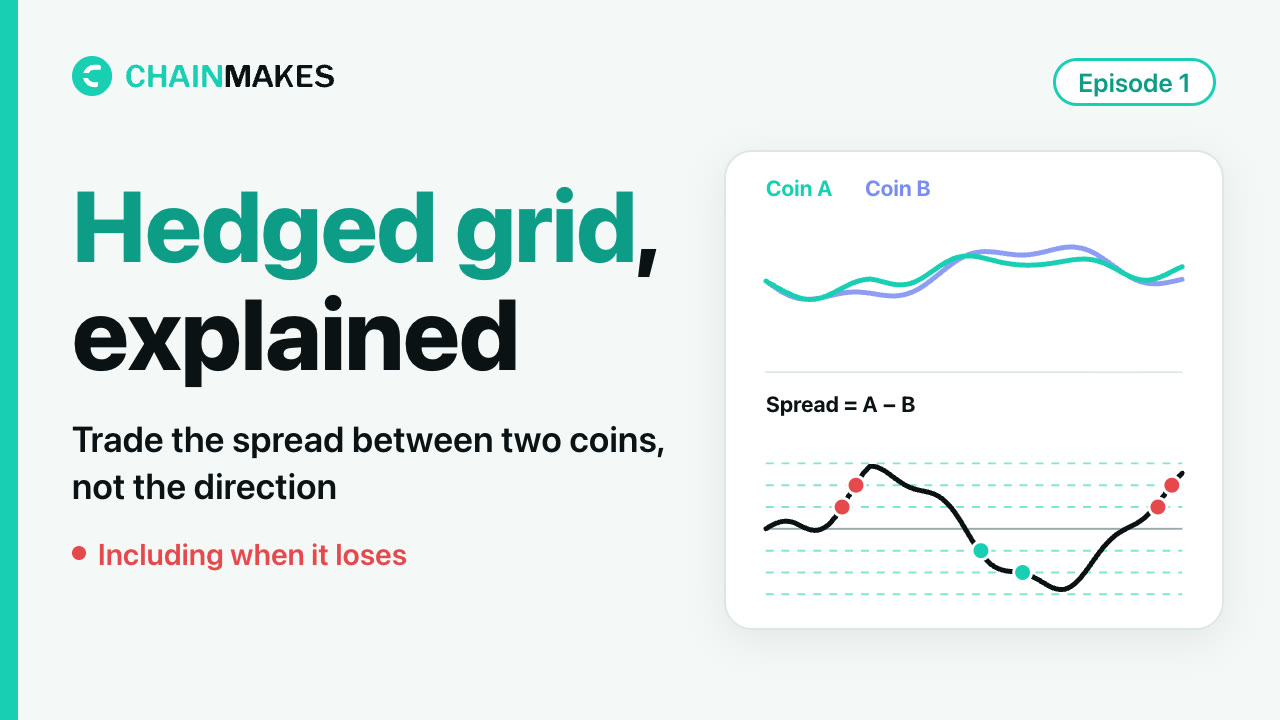
A regular grid struggles in one-way markets. A hedged grid goes long one coin and short another, and only trades their relative moves. This article explains how it opens and closes positions, where the profit comes from, and when it loses.
Can't open YouTube?Try a LumSub node subscription — Japan nodes, routes tuned for OKX, Binance and ChainMakes.
Lower quality and speed than YouTube; loads only when you click.
Contents
In one sentence: a hedged grid doesn’t bet on where the market goes. It bets that two coins that usually move together will keep drifting apart and back again. When the whole market moves, the two legs roughly cancel out. The grid only trades, and can only make money, when the gap between the two coins opens up and then closes.
The problem with a regular grid: one-way markets
An exchange’s regular grid places levels on one coin’s price: buy a little each level down, sell a little each level up. While the price chops back and forth, it keeps collecting the difference between levels.
The trouble starts when the market goes one way:
- Straight down: the grid keeps buying, the position grows, and so does the loss.
- Straight up: the grid sells out early and misses the rest of the move.
Nobody can reliably predict which way a coin will go. A regular grid leaves all of that risk with you.
Change what you trade: the relative move of two coins
Many coins are highly correlated. When the market rises they rise together; when it falls they fall together. Only the size of the move differs.
A hedged grid doesn’t watch either coin’s price. It watches the relative move between them: coin A’s change since the start minus coin B’s change since the start. We call this the spread.
| Scenario | Coin A | Coin B | Spread |
|---|---|---|---|
| Market rises together | +5% | +5% | 0 |
| Market falls together | −8% | −8% | 0 |
| A a little stronger than B | +3% | +1.9% | +1.1% |
| A a little weaker than B | −4% | −2.8% | −1.2% |
When the whole market moves, the spread barely changes. It only moves when one coin gets stronger or weaker than the other. That’s where the grid sits.
How it trades
Using the defaults of the ChainMakes standard grid: 1% step, 1% take profit, up to 10 levels, with equal size on both legs of each level.
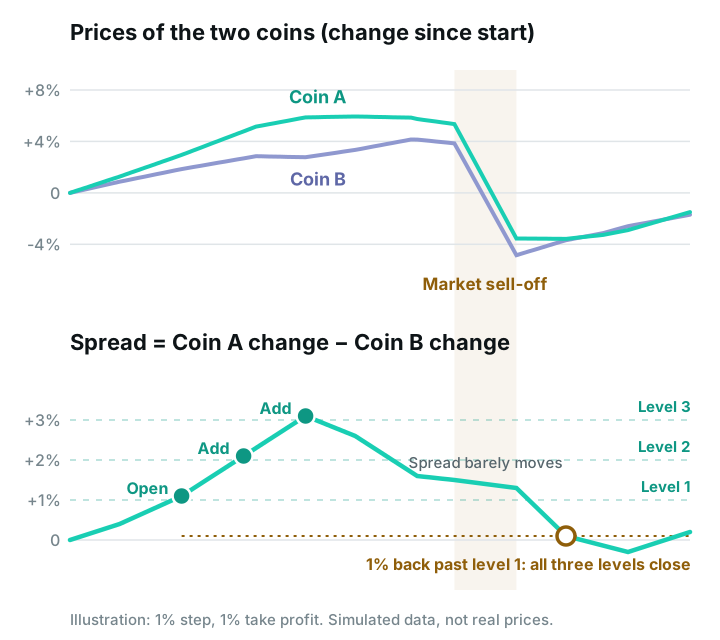
- Open the first level: when the spread moves 1% from the start, open level 1 — short the coin that rose more, long the coin that rose less. If A has outperformed B by 1.1%, short A and long B, the same amount on each leg.
- Add as it widens: each time the spread moves another 1% in the same direction from the last level, open another one, up to 10.
- Close the whole round when it comes back: when the spread moves back 1% (the take-profit distance) from where level 1 opened, every level in the round closes together. The grid then waits for the next move.
- The loss exit line is the backstop: if the loss reaches the amount you set (pre-filled at 10% of capital when you create the grid, and it can’t be left empty), everything closes and the grid stops.
It trades both directions: short A / long B when A is stronger, long A / short B when A is weaker. You don’t need to guess which coin will win — only that the spread will come back.
What one round looks like
Say your capital is 1,000 USDT, with 100 USDT per leg per level:
- The spread reaches 1% and level 1 opens; it keeps going to 2% and 3%, opening levels 2 and 3.
- Then it reverses, and when it is 1% back past where level 1 opened, all three levels close.
Level 1 captured about 1% of spread, level 2 about 2%, level 3 about 3%. At 100 USDT per leg per level, that’s roughly 1 + 2 + 3 = 6 USDT for the round, before fees and slippage.
This is a simplified example. Real fills will differ, and funding fees move the result up or down.
Why market moves matter less
The two legs are one long and one short of the same size:
- The market falls 10%: the long loses about 10 USDT, the short gains about 10 USDT. They roughly cancel.
- The market rises 10%: the long gains and the short loses. Again they roughly cancel.
That’s what “hedged” means: the market-direction risk you don’t want is offset by the other leg.
But this only works if the two coins move by similar amounts. Some coins are more sensitive to the market — they rise and fall harder. With equal-size legs, a big market move can still shift the spread. That’s one reason pairs need screening first.
Where the profit comes from
From the spread reverting: the two coins drift apart, then come back together.
So the choice of pair matters. The ChainMakes pair screener checks three things:
- Correlation: do the two coins normally move together?
- Stable mean reversion: when the spread widened in the past, did it reliably come back?
- Speed of reversion (half-life): how long does it take to come back? If it’s too slow, your capital sits tied up.
“Passes screening” only describes the recent past. It says nothing certain about the future.
When it loses
When the spread keeps moving one way and doesn’t come back.
If one of the coins has big news of its own, or money rotates out of one sector into another for weeks, the spread can keep widening. The grid adds level after level as its rules say, keeps losing once it’s full, and eventually hits the loss exit line.
This is not rare. In our historical backtest, even on pairs that pass screening:
- About half the months were profitable (48%), but those months made only about 2% on average.
- The other half lost money (52%), about 12% on average.
- Small wins and big losses: across all months, the average was a loss of about 5% per month.
A follow-up article walks through exactly how those losses build up.
Compared with a regular grid
| Regular grid | Hedged grid | |
|---|---|---|
| What it trades | One coin’s price | The relative move of two coins |
| What hurts it | One-way rallies or sell-offs | The two coins diverging and not coming back |
| Market-direction exposure | Fully exposed | The two legs roughly cancel |
| Positions needed | One leg | Two legs (one long, one short) |
| Costs | Fees on one leg | Fees on two legs, plus funding |
Who it’s for
- You already trade futures on an exchange and understand margin, leverage and liquidation.
- You don’t want to bet on direction or watch charts all day.
- You’re willing to run it on paper trading first, see how it makes and loses money, and only then decide about going live.
If you’re new to futures, or you expect a steady return every month, a hedged grid is not for you.